One of the most common questions beginners ask is simple:
“How much money do I actually need to start dropshipping?”
The internet often gives unrealistic answers. Some claim you can start with almost nothing.
Others insist you need thousands of dollars before launching.
The truth is somewhere in between.
Dropshipping does reduce many traditional ecommerce costs such as inventory and warehousing.
However, it does not eliminate startup costs entirely. There are still essential expenses involved
in building a store, testing products, and acquiring traffic.
Understanding the real cost to start dropshipping in 2026 helps set realistic expectations
and prevents beginners from quitting too early due to budget pressure.
Realistic Startup Costs
Starting a dropshipping business requires several foundational components.
Even though you are not purchasing inventory upfront, you still need the tools required
to launch and test your store.
Typical early expenses include:
- Ecommerce platform subscription
- Domain name
- Store theme or design setup
- Dropshipping apps and integrations
- Product testing budget
- Advertising costs
These costs vary depending on how you choose to build your store.
Some beginners prefer to build everything from scratch, while others start
with a professionally built store structure.
The differences between these two approaches are explained in
Build a Dropshipping Store Yourself vs Buying a Ready-Made One,
which outlines how setup decisions impact both cost and launch speed.
Shopify Costs
Shopify remains the most common platform used for dropshipping businesses.
Basic costs typically include:
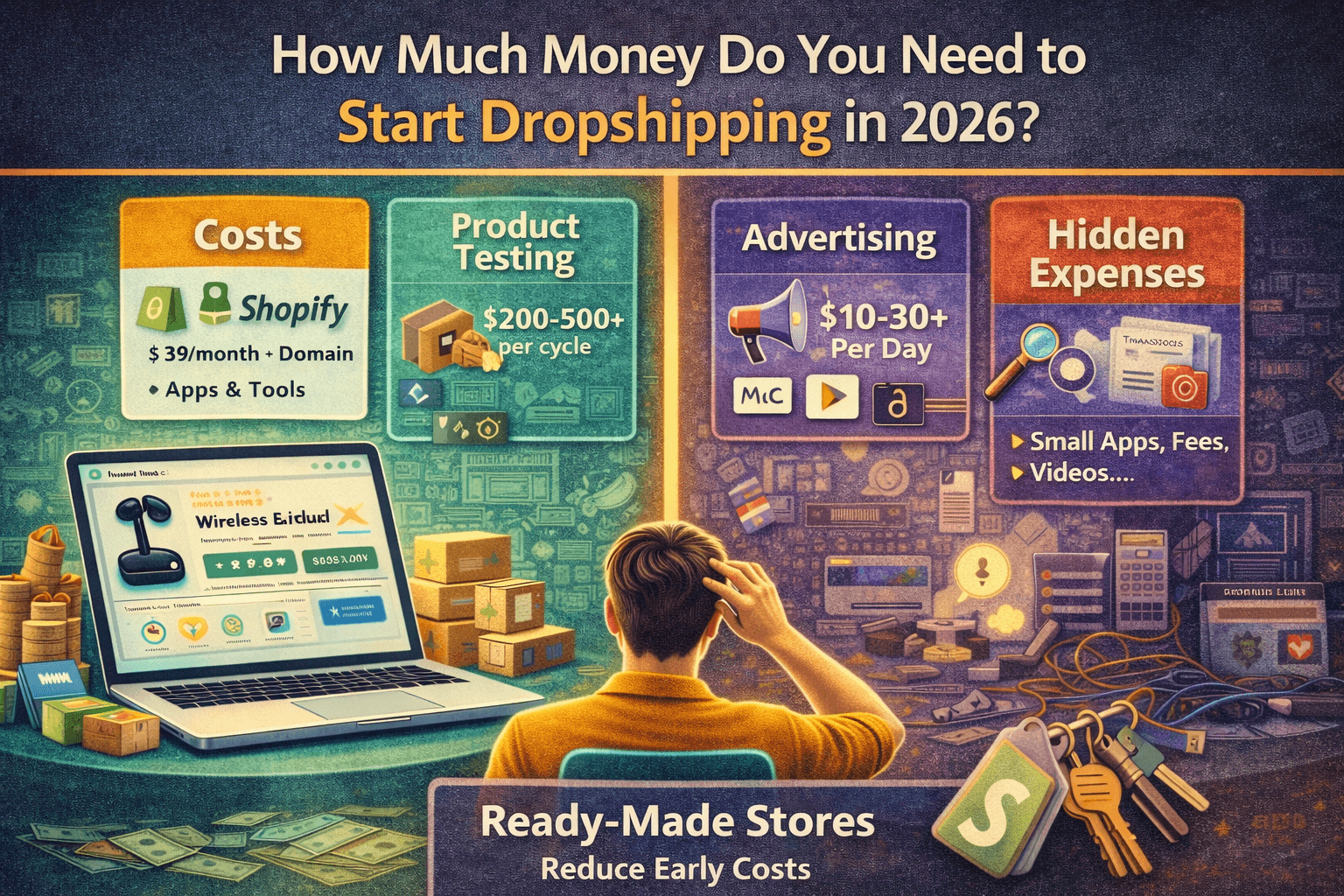
- Shopify subscription (around $39/month for the basic plan)
- Domain purchase (usually $10–$20 per year)
- Optional apps for product import, reviews, or automation
While Shopify simplifies many technical aspects, beginners often underestimate the time required
to configure themes, design pages, and structure the store correctly.
For this reason, some entrepreneurs start with a pre-built store structure instead of building
everything manually. The concept behind this approach is explained in
What Is a Ready-Made Dropshipping Store? Is It Worth Buying?
Product Testing Budgets
Product testing is where most of the real cost appears.
Dropshipping relies on testing multiple products or creative angles before finding a profitable combination.
Because of this, the budget must allow room for experimentation.
Many beginners expect the first product they test to succeed immediately.
In reality, testing is a learning process.
Typical early testing budgets often fall between:
- $200 – $500 for small testing cycles
- $500 – $1,000 for more structured testing
The purpose of this budget is not immediate profit.
It is to gather data that reveals which products and audiences respond best.
Ad Costs
Traffic acquisition is usually the largest expense in dropshipping.
Most beginners rely on advertising platforms such as:
- Meta Ads (Facebook and Instagram)
- TikTok Ads
- Google Shopping
Advertising budgets vary widely depending on strategy, but early testing campaigns often require
at least $10–$30 per day per ad set.
The goal during this phase is not aggressive scaling.
It is identifying signals such as:
- Click-through rate
- Add-to-cart activity
- Early conversion signals
Without this data, it is impossible to know whether a product has potential.
Hidden Expenses Beginners Often Ignore
Many new dropshippers focus only on platform fees and ad costs.
However, there are several smaller expenses that add up over time.
Common hidden costs include:
- Paid apps for reviews or upsells
- Product samples for content creation
- Transaction fees and payment processing
- Creative production for advertisements
Individually, these costs may seem small.
But collectively, they influence the total startup budget.
Understanding these hidden factors helps beginners plan realistically
rather than running out of budget too early.
How Ready-Made Stores Reduce Early Costs
While ready-made dropshipping stores require an upfront investment,
they can sometimes reduce indirect costs.
Instead of spending weeks experimenting with themes, layouts, and structure,
entrepreneurs begin with a professionally organized store foundation.
This reduces early mistakes related to:
- Confusing navigation
- Weak product page structure
- Missing trust elements
- Poor store positioning
Rather than investing time and money fixing these problems later,
the store starts with a clearer foundation.
However, it is important to understand that a ready-made store does not eliminate marketing costs.
It simply removes much of the uncertainty around initial setup.
Conclusion
The real cost to start dropshipping in 2026 is not zero,
but it is still far lower than traditional ecommerce.
A realistic beginner budget usually includes:
- Platform and setup costs
- Product testing budget
- Advertising expenses
- Operational tools
For many entrepreneurs, the biggest investment is not money but learning through testing.
Dropshipping success rarely happens on the first attempt.
What matters most is building a system that allows you to test ideas,
gather data, and improve over time.
Understanding these costs early helps you enter the business with realistic expectations
and a stronger chance of long-term success.


