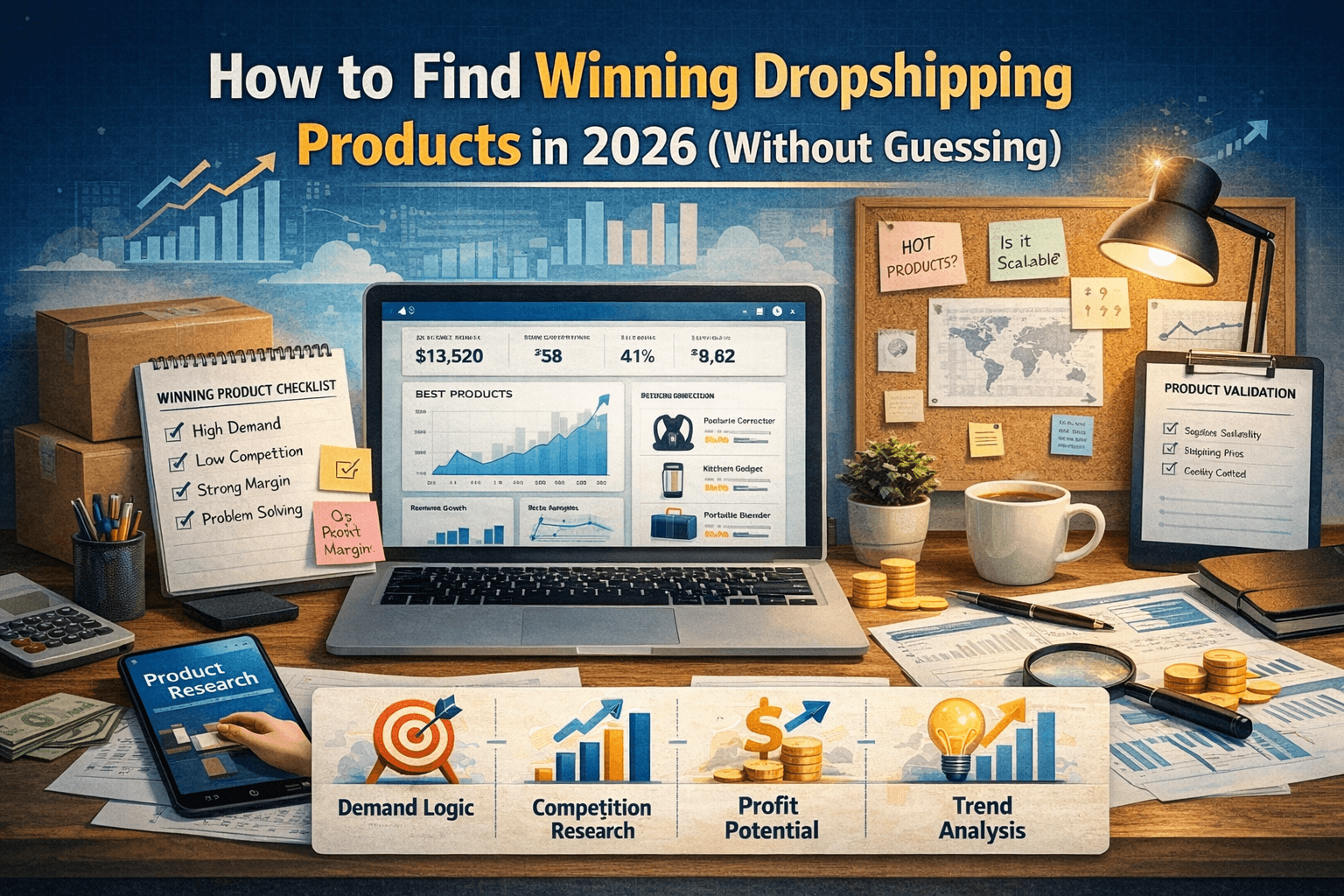
One of the biggest reasons most dropshipping stores fail has nothing to do with ads, budget, or even skill. It starts much earlier—with product selection.
Most beginners treat product research like a guessing game. They scroll through social media, look at trending products, or copy what others are selling. Sometimes they get lucky. Most of the time, they don’t.
The issue is not effort.
The issue is the lack of structure.
In 2026, dropshipping is no longer an environment where random testing works consistently. Competition is higher, customer expectations are clearer, and advertising costs punish weak decisions faster than ever.
If you want to build something sustainable, you need to stop guessing and start evaluating products using a system.
This article breaks down exactly how to do that.
Why Most Product Research Fails
Most people approach product research from the wrong direction.
They look for visibility instead of viability.
A product that appears frequently in ads or social feeds feels like a “winning product,” but that visibility often comes too late. By the time a product becomes obvious, the market is already crowded. Multiple sellers are competing on price, creatives start to look identical, and margins shrink.
This leads to a common pattern.
You find a product that looks promising, launch ads, spend money, and see no results. Then you assume the product is bad and move on to the next one.
But in many cases, the product itself wasn’t the problem.
It was the timing, positioning, or structure around it.
This is closely connected to what happens at the store level. As explained in Why Most Dropshipping Stores Fail, weak foundations distort results and make it difficult to understand what is actually working.
Product research fails not because products don’t exist.
It fails because the evaluation process is flawed.
What a Winning Product Actually Looks Like
A winning product is not defined by hype or trend.
It is defined by structure.
That means the product must be able to survive and perform inside a real business environment—not just generate initial attention.
First, it needs to solve a clear problem or create a meaningful benefit. If the value is not immediately understandable, customers will not engage.
Second, it must have consistent demand. Not just short-term spikes, but ongoing relevance. This ensures that you have enough time to test, optimize, and improve your campaigns.
Third, the product must support margins. If there is no room for advertising costs, refunds, and operational expenses, scaling becomes impossible.
Finally, it needs flexibility. You should be able to present the product in different ways, target different audiences, and test different angles.
Most beginners focus on how a product looks.
Experienced operators focus on how a product behaves.
Demand vs Temporary Trends
Understanding the difference between demand and trend is critical.
A trending product may generate attention quickly, but that attention is often unstable. Trends rise fast and disappear just as quickly. If you enter too late, you are competing in a saturated market. If you enter too early, the demand may not be proven yet.
This creates a narrow window where success is possible.
Demand, on the other hand, is stable.
Products tied to ongoing needs—such as convenience, health, pets, home improvement, or lifestyle—offer longer testing periods. You are not racing against time. You have room to experiment, gather data, and improve performance.
This is why niche clarity matters.
If you are unsure how to approach niches from a structural perspective, it helps to understand how demand is distributed across categories in Best Dropshipping Niches for 2026.
Stable demand does not guarantee success.
But it gives you time to build it.
Evaluating Competition the Right Way
Competition is often misunderstood.
Many beginners avoid competitive products entirely, assuming that competition means saturation. In reality, competition often validates demand. If multiple sellers are investing in ads, it means the product is working for someone.
The real question is not whether competition exists.
The question is whether you can compete effectively.
If all sellers are offering the same product in the same way, your only advantage becomes price. This leads to lower margins and unsustainable scaling.
Instead, look for opportunities to differentiate.
Can you position the product differently?
Can you target a specific audience?
Can you present the product as a solution rather than just an item?
Winning products are not always unique.
But winning approaches usually are.
Understanding Margin Before Testing
One of the most common mistakes beginners make is focusing on low-cost products instead of profitable ones.
A product may be cheap to source, but that does not mean it is scalable.
You need to consider the full cost structure:
- Advertising costs
- Transaction fees
- Shipping expenses
- Refund risk
- Operational overhead
If your product cannot support these costs, you will struggle to maintain profitability even if you generate sales.
A practical benchmark is aiming for at least a 3x margin between your landed cost and selling price. This gives you enough room to test ads, absorb losses, and still have potential for profit.
Without margin, every test becomes risky.
With margin, testing becomes sustainable.
Psychological Drivers Behind Buying Decisions
Products do not sell because they exist.
They sell because they trigger something.
A strong product connects with a clear psychological driver. It may solve a visible problem, improve a person’s lifestyle, or create an emotional response.
For example, products related to appearance, comfort, convenience, or personal identity tend to perform well because they connect with how people see themselves.
If a product does not trigger a strong reaction, your marketing will rely entirely on discounts or aggressive offers.
That approach does not scale well.
The stronger the psychological pull, the easier it is to communicate value.
Creative Potential and Scalability
Before you test a product, you should be able to imagine how it can be marketed.
If every advertisement looks the same, your campaigns will quickly become ineffective.
A strong product allows for multiple creative approaches.
You can demonstrate the problem and solution, show transformations, highlight user experiences, or position it as a gift. Each angle allows you to test different messaging and identify what resonates most with your audience.
If you struggle to come up with different ways to present the product, it is a sign that the product lacks depth.
And without depth, scaling becomes difficult.
Operational Reality
Even if a product looks perfect from a marketing perspective, it can still fail operationally.
Supplier reliability, shipping time, and product quality all play a role in long-term success.
If customers receive damaged products, experience delays, or feel misled, trust breaks quickly.
And once trust is lost, scaling becomes significantly harder.
A winning product is not just easy to sell.
It is reliable to deliver.
Conclusion
Finding winning dropshipping products in 2026 is not about luck, trends, or copying competitors.
It is about structure.
A good product is one that can handle real-world pressure—demand, competition, margin, psychology, and execution.
When you shift from guessing to evaluating, product research becomes more predictable.
You stop chasing what looks exciting.
You start choosing what can actually work.
The goal is not to find a perfect product.
The goal is to find a product that can be tested properly, improved over time, and scaled without breaking.
Because in dropshipping, success is not built on one lucky product.
It is built on better decisions, made consistently.


