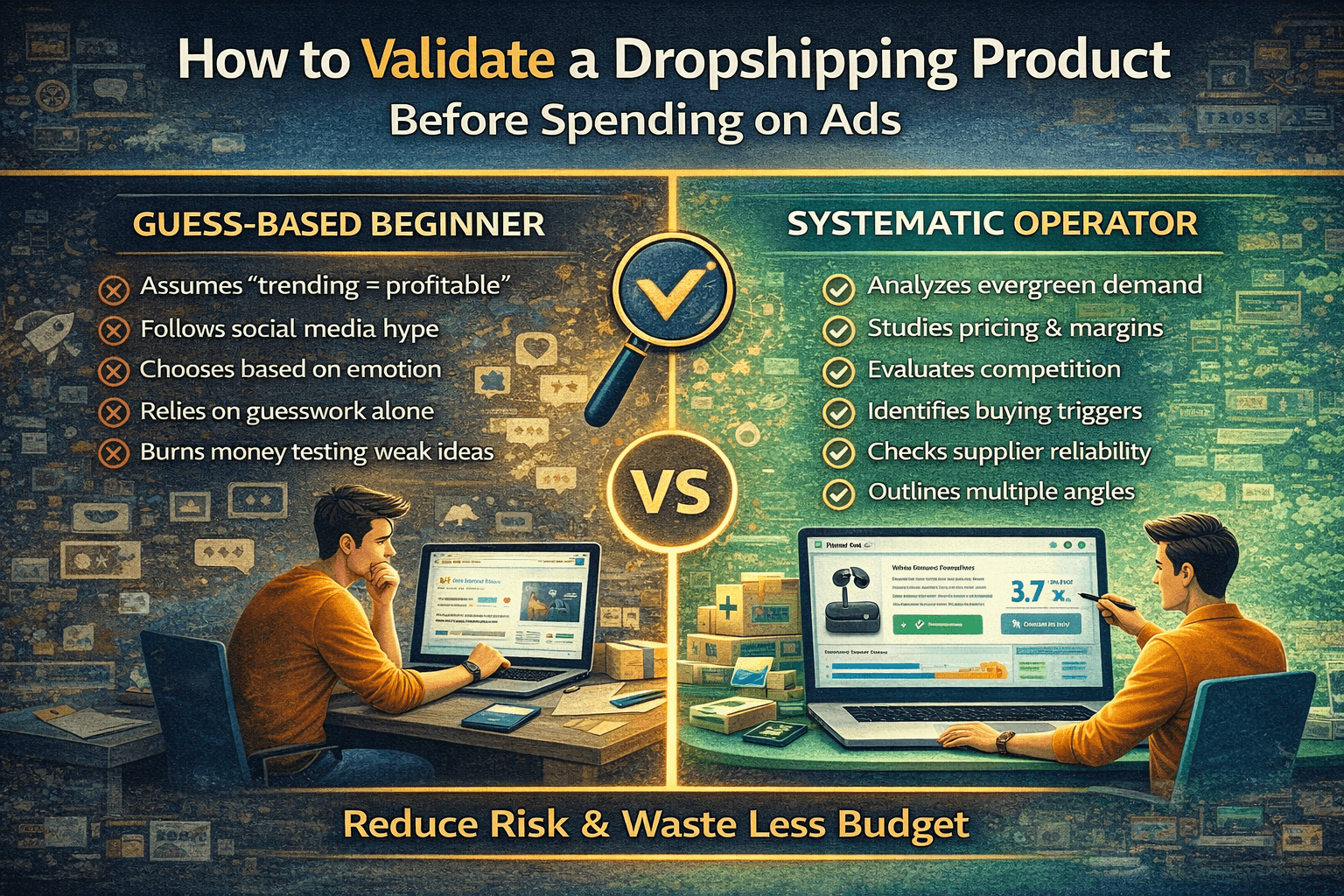
Most beginners lose money in dropshipping not because ads are impossible — but because they skip validation.
They launch campaigns based on trends, emotion, or what “looks cool,” instead of structured analysis.
Learning how to validate a dropshipping product before spending on ads is the single biggest difference between
systematic operators and guess-based beginners.
Validation does not guarantee success. What it does is reduce uncertainty. It helps you avoid structurally weak
products before you burn budget testing them.
Why Product Validation Matters
Paid ads amplify what already exists. If the product-market fit is weak, ads will simply reveal that faster.
Without validation, you cannot distinguish between:
- A bad product
- A weak store structure
- Unclear positioning
- Poor creative angles
This is one of the structural failure patterns explained in
Why Most Dropshipping Stores Fail.
Clean validation allows cleaner testing.
What “Validation” Actually Means
Validation does not mean “this product is trending.” It means the product meets structural conditions that allow
profitable scaling.
A validated product should show:
- Consistent buyer intent
- Room for margin after ad costs
- Clear psychological buying triggers
- Creative differentiation potential
- Operational reliability
Without these factors, even high-demand products collapse under real advertising pressure.
Step 1: Demand Analysis (Beyond Hype)
Demand is necessary — but it must be structural, not temporary.
Look for:
- Stable search volume over time (not sudden spikes)
- Recurring problem relevance
- Active communities discussing the issue
- Existing paid ads running consistently
Trend spikes often disappear before optimization is complete. Evergreen demand provides longer testing windows.
For deeper niche logic, see
Best Dropshipping Niches for 2026.
Step 2: Competition & Market Structure
High demand is meaningless if the market structure prevents differentiation.
Ask:
- Is Amazon dominating this exact product?
- Are margins already compressed by marketplaces?
- Can you position differently (bundle, angle, identity)?
- Is the audience emotionally attached or purely price-driven?
If the only competitive advantage is price, margins collapse. Strong products allow branding,
storytelling, or problem framing.
Step 3: Price Tolerance & Margin Logic
Many beginners validate based on “low cost” instead of margin structure.
Your product must support:
- Ad cost (CPA)
- Refund risk buffer
- Transaction fees
- Operational overhead
If a product can only sell at $19 and sourcing + shipping costs $12, scaling becomes mathematically difficult.
A healthy validation rule: Aim for at least 3x–4x markup from landed cost.
Step 4: Psychological Buying Drivers
Strong products align with at least one of these drivers:
- Pain avoidance (fixes a real problem)
- Identity reinforcement (fitness, pets, hobbies)
- Emotional attachment
- Urgency
When psychological pull is weak, ads rely entirely on discounts — which destroys scalability.
Step 5: Creative Angle Depth
Before running ads, you should be able to outline at least 5–7 distinct creative angles.
If every ad looks identical, scaling will stall.
Examples:
- Problem-solution demonstration
- Before-after transformation
- Testimonial angle
- Comparison vs alternative
- Gift positioning
If you cannot create angle diversity, the product lacks creative depth.
Step 6: Supply & Operational Risk
A product may look profitable on paper but fail operationally.
Check:
- Supplier consistency
- Shipping times
- Return likelihood
- Product defect rates
High return rates destroy margin. Slow shipping destroys trust. Operational friction kills scaling.
Step 7: Store Structure Alignment
Even a validated product fails inside a weak store. The product must align with niche clarity and store architecture.
If your store structure is unclear, revisit
Build vs Buy a Dropshipping Store – Which Is Better in 2026?.
Structural clarity reduces data distortion during testing.
Final Validation Checklist
Before running ads, your product should pass these checks:
- Stable and recurring demand
- Room for 3x–4x markup
- Emotional or practical buying trigger
- Angle diversity for creatives
- Operational reliability
- Store positioning alignment
If a product fails multiple criteria, don’t “test and hope.” Fix the structural issue first.
Conclusion
Learning how to validate a dropshipping product before spending on ads is about reducing risk — not eliminating it.
The goal is not to find a perfect product. The goal is to ensure your system can test efficiently without burning
budget blindly.
Dropshipping rewards structured decision-making. Validation is the first layer of structure.


