Most people fail at dropshipping long before ads, scaling, or profitability even become relevant. The failure usually happens at the foundation stage.
Store setup, niche clarity, product architecture, and trust signals are where beginners lose direction.
This is not because ecommerce is inherently complex, but because decision density is highest at the beginning — when experience is lowest.
A ready-made dropshipping store exists to reduce that decision density by providing a pre-structured starting point.
If you want to understand how these early mistakes destroy stores, read
Why Most Dropshipping Stores Fail – Structural & Technical Reasons.
Instead of forcing beginners to design a business without understanding ecommerce fundamentals, it gives them a system that is already organized
around conversion flow. However, whether buying one is worth it depends entirely on how it is used and who is using it.
What Is a Ready-Made Dropshipping Store?
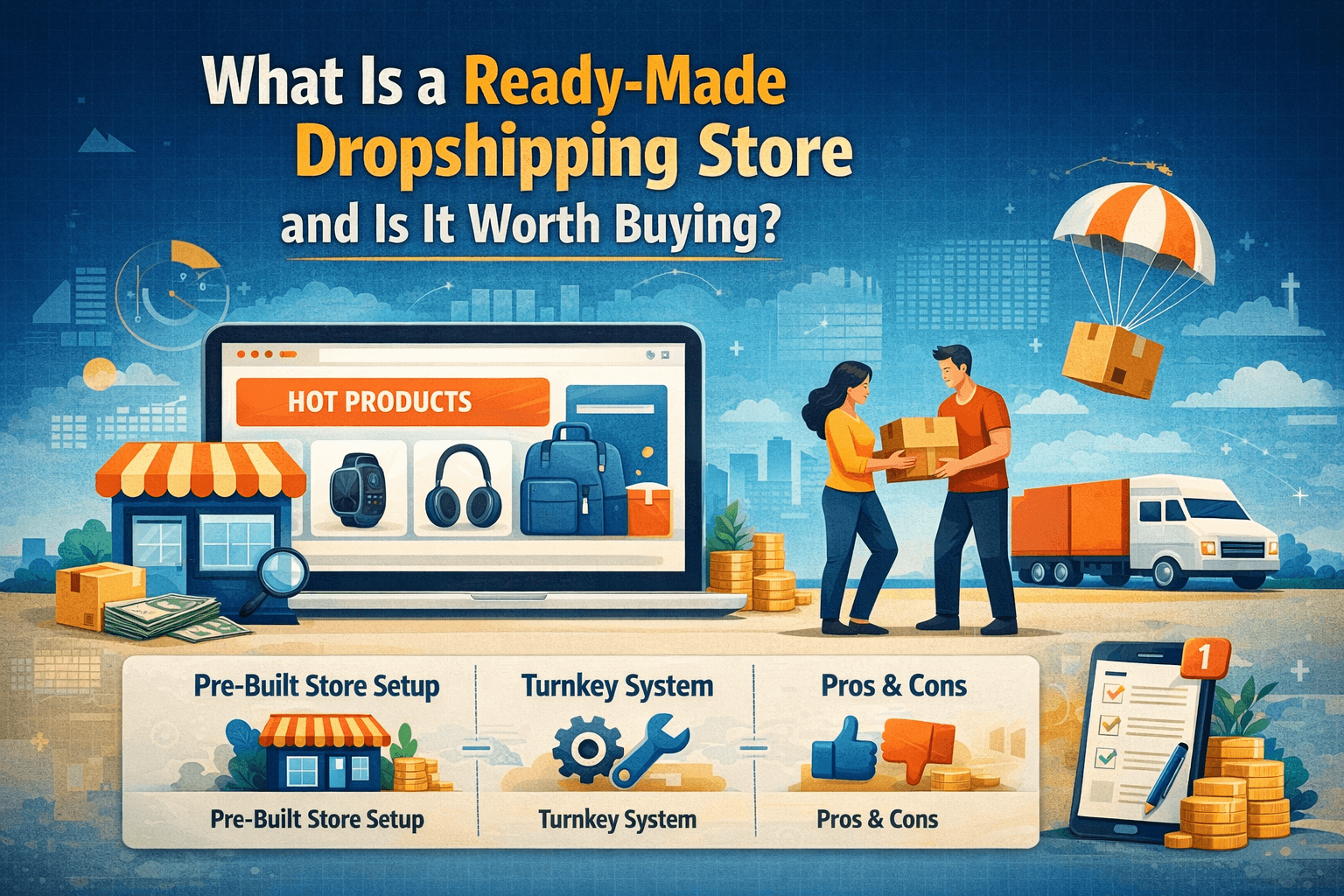
A ready-made dropshipping store is a pre-built ecommerce website designed specifically for dropshipping. Technically speaking, it is not a finished business.
It is a pre-configured ecommerce system built to reduce setup mistakes and accelerate launch.
It typically includes:
- A defined niche or product category
- Pre-installed ecommerce platform (usually Shopify)
- Professionally structured homepage
- Pre-loaded product pages
- Navigation and category structure
- Policy pages (Refund, Shipping, Privacy, Terms)
- Branded design and visual identity
- Basic trust elements (reviews layout, guarantees, FAQs)
In simple terms, it removes the technical and structural burden of building from scratch. You may also see it described as a pre-built dropshipping website,
a turnkey dropshipping store, or a store you can launch immediately after minor customization.
What a Quality Ready-Made Store Actually Includes
The difference between a serious ready-made dropshipping store and a random theme template lies in intentional structure.
A quality store is built with conversion logic in mind, not just visual design.
A proper store should include:
- Structured homepage flow (value proposition → proof → CTA)
- Conversion-oriented product page architecture
- Logical navigation and category hierarchy
- Trust pages and clarity elements that reduce risk
This structure matters because traffic does not convert based on aesthetics. It converts based on clarity, trust sequencing, and friction removal.
Choosing the right niche also plays a critical role here — explore
Best Dropshipping Niches for 2026 – How to Choose Niches That Scale.
Why Store Setup Is the Highest-Risk Phase in Dropshipping
Early-stage dropshipping has the highest failure rate because it combines maximum uncertainty, irreversible decisions, and zero performance data.
Theme selection, product placement, pricing display, trust signals, and niche framing all influence conversion rate — but beginners lack feedback loops.
Many assume ads will “fix” weak structure. In reality, ads amplify existing problems. If the store structure is weak, bounce rate increases,
conversion rate drops, cost per purchase rises, and ad data becomes misleading.
This often causes entrepreneurs to abandon potentially winning products simply because the store could not convert traffic.
How Ready-Made Stores Reduce Structural Risk
Buying a turnkey dropshipping store narrows the number of unknown variables. Instead of questioning whether your homepage is wrong,
your product pages are missing something, or your store looks untrustworthy, you can focus on controllable variables.
That usually shifts attention toward:
- Ad creatives
- Audience targeting
- Offer testing
- Pricing strategy
This is critical because learning in ecommerce happens through testing. If your structure is unstable, your tests become unreliable.
A ready-made store does not eliminate market risk — but it removes foundation-level confusion.
What a Ready-Made Dropshipping Store Does NOT Solve
It is important to understand what you are not buying. A ready-made dropshipping store does not automate success.
It removes structural indecision, not execution responsibility.
A ready-made dropshipping store does not:
- Choose winning ad creatives
- Optimize your Meta or Google campaigns
- Guarantee product-market fit
- Set pricing strategy
- Replace marketing skills
- Remove the need for testing
If you buy a ready-made store expecting automatic income, you will be disappointed.
If you buy it to accelerate your learning curve and reach feedback faster, it can be strategically valuable.
Is It Worth Buying in 2026?
The rational way to evaluate this is time-to-feedback. In ecommerce, the faster you test, the faster you learn, improve, and identify winning patterns.
If buying a ready-made dropshipping store allows you to launch weeks earlier than building from scratch, that acceleration has real value.
Because:
- Time saved = earlier data
- Earlier data = faster decisions
- Faster decisions = better long-term outcomes
However, it is worth buying only if you understand you still need to test, you are willing to iterate,
and you treat it as a foundation — not a finished business.
When Buying One Makes Sense
It makes strategic sense if:
- You lack technical experience
- You want to avoid beginner structural mistakes
- You want to focus on marketing rather than store design
- You value speed over experimentation
- You understand ecommerce fundamentals but don’t want to build from scratch
It does not make sense if:
- You expect passive income without testing
- You are not willing to run ads
- You want guaranteed profits
- You are unwilling to refine the store further
Conclusion
A ready-made dropshipping store is not a shortcut to success. It is a shortcut to starting from a structurally sound position.
It reduces early-stage friction, accelerates launch speed, and minimizes beginner structural errors — but execution still determines outcome.
In 2026, competition is higher than ever. Speed, clarity, and structured testing matter more than design experimentation.
If used correctly, buying a ready-made dropshipping store is not an emotional purchase — it is a strategic decision to reduce risk
at the most fragile stage of ecommerce.


