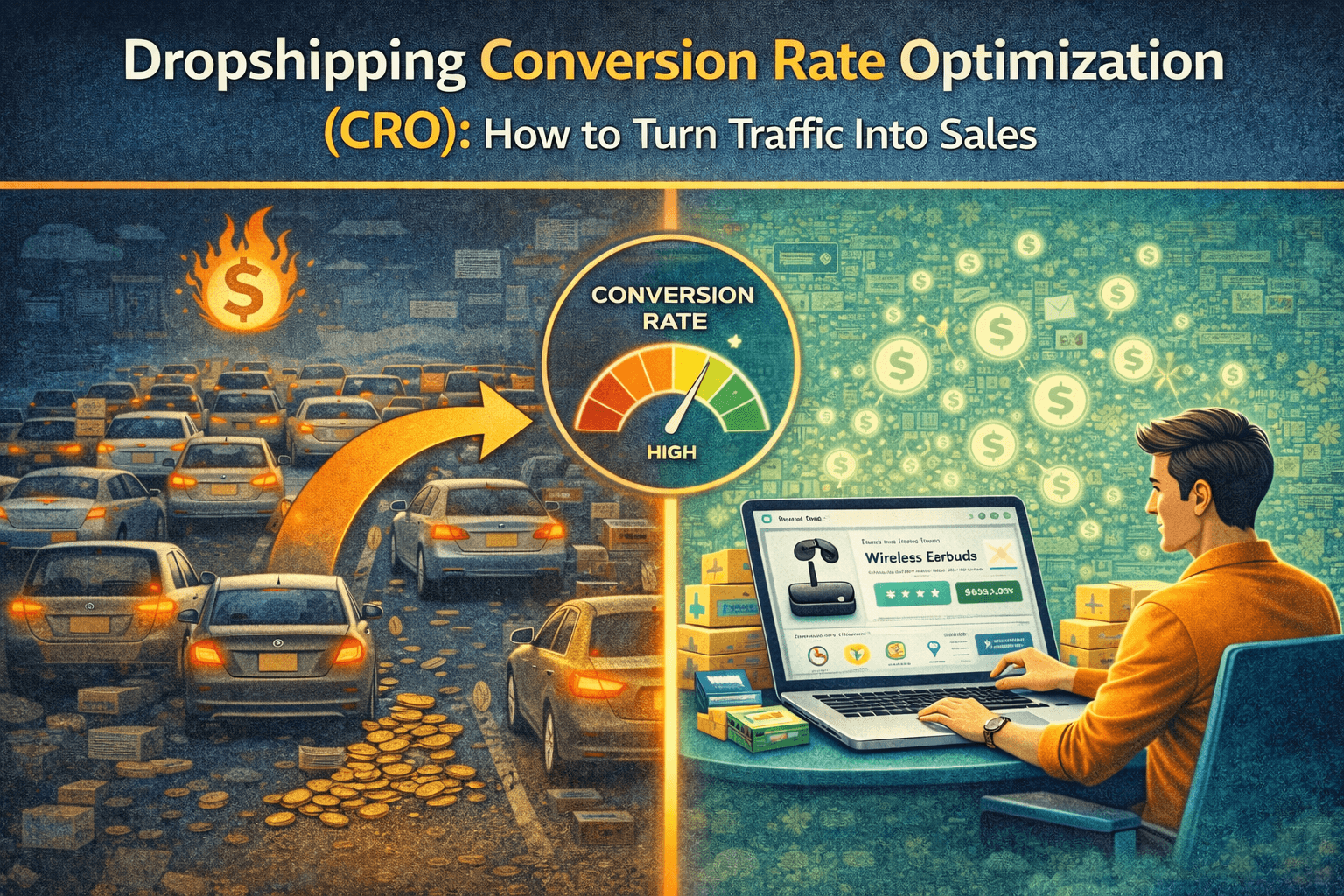
Most dropshipping beginners believe their problem is traffic. They launch new campaigns,
test new creatives, and increase budgets.
But they rarely ask a more uncomfortable question: what if the traffic isn’t the problem?
What if the store simply isn’t converting?
Dropshipping conversion rate optimization is the difference between burning money and building margin.
If your store converts at 1%, you need twice the traffic compared to a store converting at 2%.
That gap grows quickly — especially in 2026, where traffic costs are no longer cheap.
Optimization is no longer optional. It is structural.
What Conversion Rate Really Means
Conversion rate is often treated as a simple metric: sales divided by visitors.
But in reality, it measures something deeper.
It measures how clearly your store communicates relevance, trust, value, and safety.
When someone lands on your site, they’re silently asking:
- Is this for me?
- Can I trust this store?
- Is this worth the price?
- What happens if something goes wrong?
If your store answers those questions quickly and confidently, conversion increases.
If it creates hesitation, people leave.
Most stores don’t lose customers because the product is terrible.
They lose them because uncertainty is left unresolved.
The Real Reason Most Stores Don’t Convert
In many cases, the product is not the issue.
The issue is structure.
- Weak above-the-fold sections
- Confusing product pages
- No clear benefit explanation
- No risk reversal
- No emotional connection
These aren’t cosmetic problems — they are friction points.
And friction is expensive.
This is why many entrepreneurs assume their ads are failing when the real bottleneck
is inside the site itself. This structural failure pattern is explored in detail in
Why Most Dropshipping Stores Fail.
The First Five Seconds Decide Everything
The most critical part of your store is what visitors see immediately — before they scroll.
If someone cannot understand what the product is, who it’s for, and why it matters
within a few seconds, the chance of conversion drops dramatically.
Strong above-the-fold sections are simple. They communicate a clear benefit,
not a vague description. They make the product feel relevant immediately.
Weak above-the-fold sections force visitors to scroll for clarity.
Many won’t.
And when they don’t, your bounce rate rises — and your ad performance suffers.
Why Product Page Flow Matters More Than Design
Many beginners focus on how their store looks.
Far fewer think about how their product page flows.
A strong product page doesn’t just list features.
It guides the visitor psychologically.
It starts by reminding them of the problem.
Then it introduces the solution.
Then it expands on benefits.
Then it reduces objections.
Then it reinforces trust.
The order matters.
If you jump straight into specifications without emotional framing,
the product feels cold.
If you focus only on hype without addressing objections,
the purchase feels risky.
Buying is emotional first. Logical second.
Your page must reflect that.
Many of these structural principles are already built into professionally structured
stores. If you’re unsure about your store foundation, it helps to understand
What a Ready-Made Dropshipping Store Actually Is
and how store architecture affects conversion.
Trust Is Built Quietly
Visitors don’t consciously evaluate trust.
They feel it.
Consistency in layout. Clear policies. Transparent shipping timelines.
Realistic guarantees. Contact visibility.
Each element reduces hesitation slightly.
Individually, they seem small.
Together, they determine whether someone feels safe enough to buy.
A store can look modern and still feel untrustworthy
if key information is hidden or vague.
Trust is not about adding a few badges.
It is about removing uncertainty.
Mobile Optimization Is No Longer Optional
Most dropshipping traffic in 2026 comes from mobile devices.
That means your store is not being browsed carefully on a large screen.
It is being scanned quickly on a small one.
Long blocks of text feel overwhelming.
Hidden call-to-action buttons kill momentum.
Slow-loading images destroy patience.
Mobile optimization is about reducing effort.
The easier it is to understand and act,
the higher your conversion rate climbs.
If someone has to zoom, scroll excessively,
or search for the “Add to Cart” button,
you’ve already introduced friction.
Price Is About Perception, Not Just Discounts
Lowering price does not automatically increase conversion.
Sometimes it lowers perceived quality.
What actually increases conversion is value clarity.
When visitors understand why the product is worth the price,
hesitation decreases.
This can come from benefit framing, comparisons,
bundles, or simply making the outcome more tangible.
If the only reason to buy is “it’s cheaper,”
scaling becomes fragile.
Strong conversion comes from perceived value,
not aggressive discounting.
Reducing Cognitive Overload
One overlooked reason niche stores often outperform general stores is clarity.
When someone lands on a niche store,
they immediately understand who the brand is for.
There’s no confusion.
No distraction.
General stores often fail not because they lack products —
but because they fragment attention.
Visitors must mentally filter options
before deciding if the store fits them.
Every extra decision increases cognitive load.
And higher cognitive load reduces conversion.
Clarity converts.
This is one of the reasons many entrepreneurs start with
niche-focused stores rather than general stores, which is discussed in
Build vs Buy a Dropshipping Store – Which Is Better in 2026?.
Using Data to Improve — Not Panic
Optimization is not about redesigning your store every week.
It’s about reading signals calmly.
If many people add to cart but few purchase,
trust or checkout friction may be the issue.
If people leave quickly,
positioning or above-the-fold clarity might be weak.
If sessions are long but sales are low,
value perception could be unclear.
Each metric tells a story.
CRO is about diagnosing the right story —
not reacting emotionally to every fluctuation.
Conclusion
Dropshipping conversion rate optimization is not about flashy design
or clever tricks.
It is about structured persuasion.
Every visitor arrives with silent questions.
Your job is to answer them quickly,
clearly, and confidently.
Higher conversion means lower customer acquisition cost.
Lower acquisition cost means healthier margins.
Healthier margins mean sustainable scaling.
Traffic brings people to your store.
Optimization is what turns them into customers.


