When people say “dropshipping doesn’t work,” what they usually mean is their store didn’t work. This distinction matters.
Dropshipping as a fulfillment model is neutral. It does not succeed or fail on its own. What fails is the system built around it.
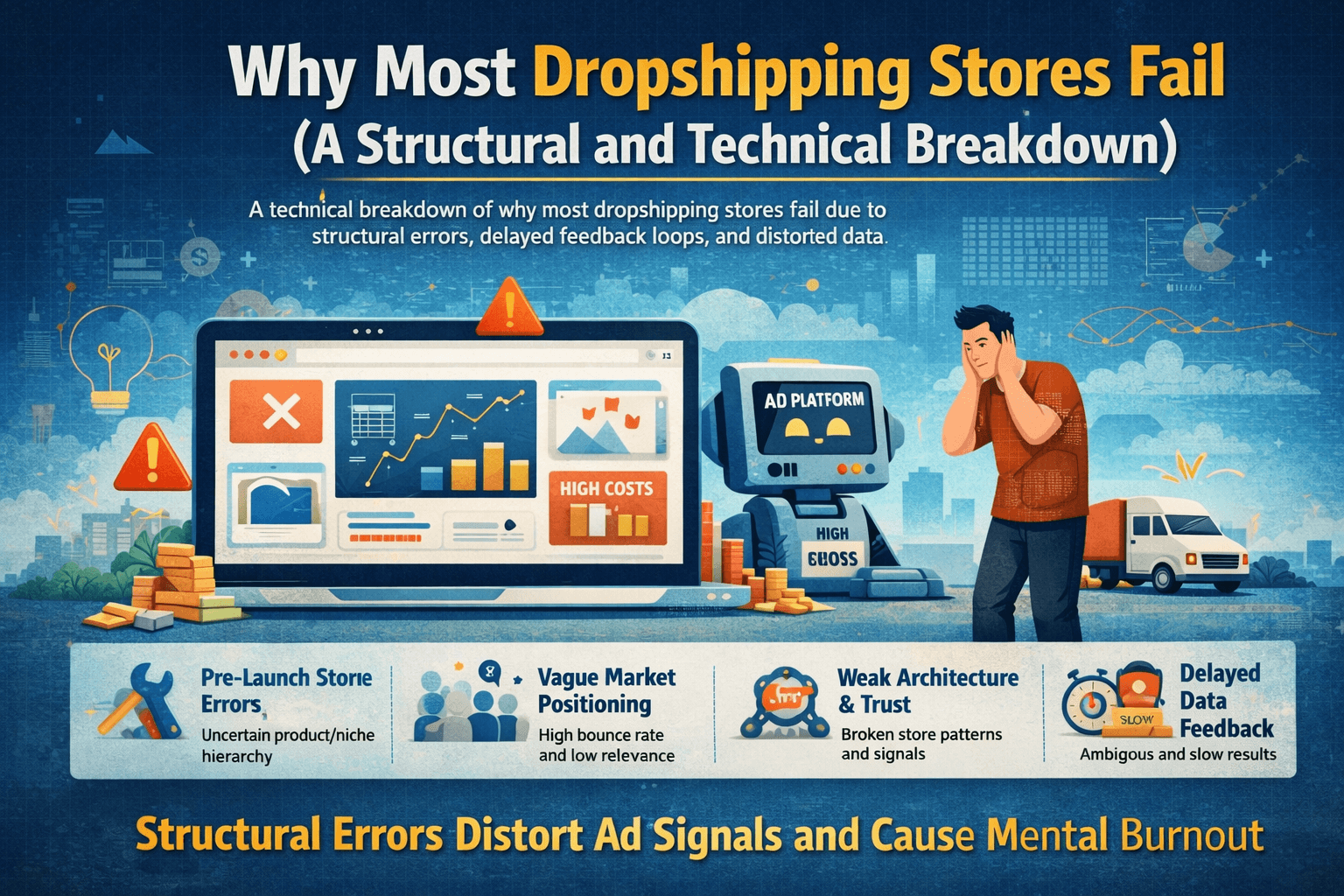
Most dropshipping stores fail before they ever reach meaningful data. Not because the product is bad, not because ads are impossible,
but because structural errors distort every signal the business receives. Once signals are distorted, decisions become wrong,
budgets are misallocated, and confidence collapses.
This article breaks down exactly why this happens — not at a motivational level, but at a technical, system-design level.
If you want to see how a structured starting point can reduce early-stage mistakes, read
What Is a Ready-Made Dropshipping Store? Is It Worth Buying in 2026?.
Failure Starts Before Traffic Is Even Sent
The most dangerous stage in dropshipping is not scaling — it is pre-launch. At this stage, beginners make decisions that permanently affect
conversion rates, trust, and learning speed.
Without experience, people are forced to decide:
- How many products a store should have
- How products should be grouped into collections
- What information belongs above vs. below the fold
- What signals build trust for cold traffic
- Which pages must exist to reduce hesitation (policies, FAQ, about, contact)
These are not cosmetic decisions. They are conversion mechanics. When they are wrong, traffic quality becomes irrelevant.
This is why foundational clarity plays a critical role early on — especially when you want to launch faster with fewer unknowns.
Undefined Market Positioning Creates Conversion Noise
A store without a clear market position creates cognitive friction. Visitors cannot quickly answer:
“Is this store for me?”
From a technical perspective, this leads to conversion noise — the store receives mixed signals that look like “bad ads”
when the real bottleneck is unclear positioning.
Common outcomes include:
- High bounce rates
- Low session duration
- Poor relevance feedback from ad platforms
Weak Store Architecture Destroys Trust Subconsciously
Most trust decisions are subconscious. Visitors do not think “this store looks bad.” They simply hesitate and leave.
Technically, trust is built through:
- Predictable navigation flow
- Familiar ecommerce layouts
- Clear product hierarchy
- Logical information sequencing
DIY stores often violate these patterns because beginners design based on taste, not buyer psychology.
This structural weakness causes conversion rates to collapse silently.
Delayed Feedback Loops Kill Learning
Another critical failure point is delayed feedback. Beginners often spend weeks refining stores before sending traffic.
From a systems perspective, this is catastrophic.
Without traffic:
- Assumptions cannot be tested
- Products cannot be validated
- Messaging cannot be refined
- Learning stalls
Data Distortion Creates False Negatives
Most beginners think they are “testing products.” But if the store structure is weak, they are actually testing structural problems.
This leads to false negatives where viable products get abandoned because the store cannot convert traffic.
Common distortion sources include:
- Slow mobile load speed and heavy theme scripts
- Weak above-the-fold clarity (no clear benefit + CTA)
- Missing proof (no review structure, guarantees, or clarity)
- Unclear shipping/returns (risk stays high)
Psychological Failure Caused by Structural Uncertainty
When everything is uncertain — niche, store, product, ads — every failure feels personal. This creates emotional fatigue.
Technically, the problem is too many unknown variables at once.
Humans do not perform well under that level of ambiguity. Businesses collapse not because they are unviable,
but because they become mentally unsustainable.
Conclusion
Most dropshipping stores fail due to structural misalignment, not bad luck. Clear positioning, correct store architecture,
and faster feedback loops dramatically increase survival rates. Dropshipping success is not about finding secrets —
it is about designing a system that can actually learn.
If you’re deciding whether to start from scratch or start from a structured base, compare both paths in
Build vs Buy a Dropshipping Store – Which Is Better in 2026?.


